Nocturnal Predators: Guardians of the Night
As the sun sets over Rancho SMC and darkness blankets the landscape, a hidden world awakens. The nocturnal predators of our region—bobcats, owls, and bats—emerge from their daytime refuges to begin their nightly hunts. These remarkable creatures are not merely inhabitants of the night; they are essential guardians of ecological balance, controlling prey populations and maintaining the health of our ecosystems. Through our innovative camera trap program, we're unveiling unprecedented insights into their secretive lives and the critical role they play in wildlife conservation.
The Silent Stalker: Bobcats in Our Midst
The bobcat (Lynx rufus) represents one of North America's most adaptable and resilient predators. At Rancho SMC, these elusive felines have become a focal point of our conservation research, revealing behaviors and habitat preferences that challenge previous assumptions about their territorial ranges and hunting patterns.
Our camera trap data from the past eighteen months has documented a stable population of at least seven individual bobcats utilizing the preserve's diverse habitats. These medium-sized cats, weighing between 15 and 35 pounds, demonstrate remarkable versatility in their hunting strategies. Unlike their larger cousin the mountain lion, bobcats rely on stealth and patience rather than sustained pursuit, often waiting motionless for hours before launching a lightning-fast ambush on unsuspecting prey.
The ecological importance of bobcats cannot be overstated. As mesopredators—predators of intermediate size in the food chain—they occupy a crucial niche in controlling populations of rabbits, rodents, ground-dwelling birds, and occasionally young deer. This predation pressure prevents overgrazing and maintains plant community diversity, creating a cascade of positive effects throughout the ecosystem. Research indicates that areas with healthy bobcat populations show 30-40% greater plant diversity compared to regions where these predators have been eliminated.
What makes our recent findings particularly exciting is the documentation of bobcat activity in areas previously thought unsuitable for their habitation. Camera traps positioned near seasonal wetlands have captured multiple instances of bobcats hunting waterfowl and amphibians, demonstrating dietary flexibility that enhances their survival prospects in changing environmental conditions. This adaptability may prove crucial as climate change continues to alter traditional prey availability and habitat characteristics.
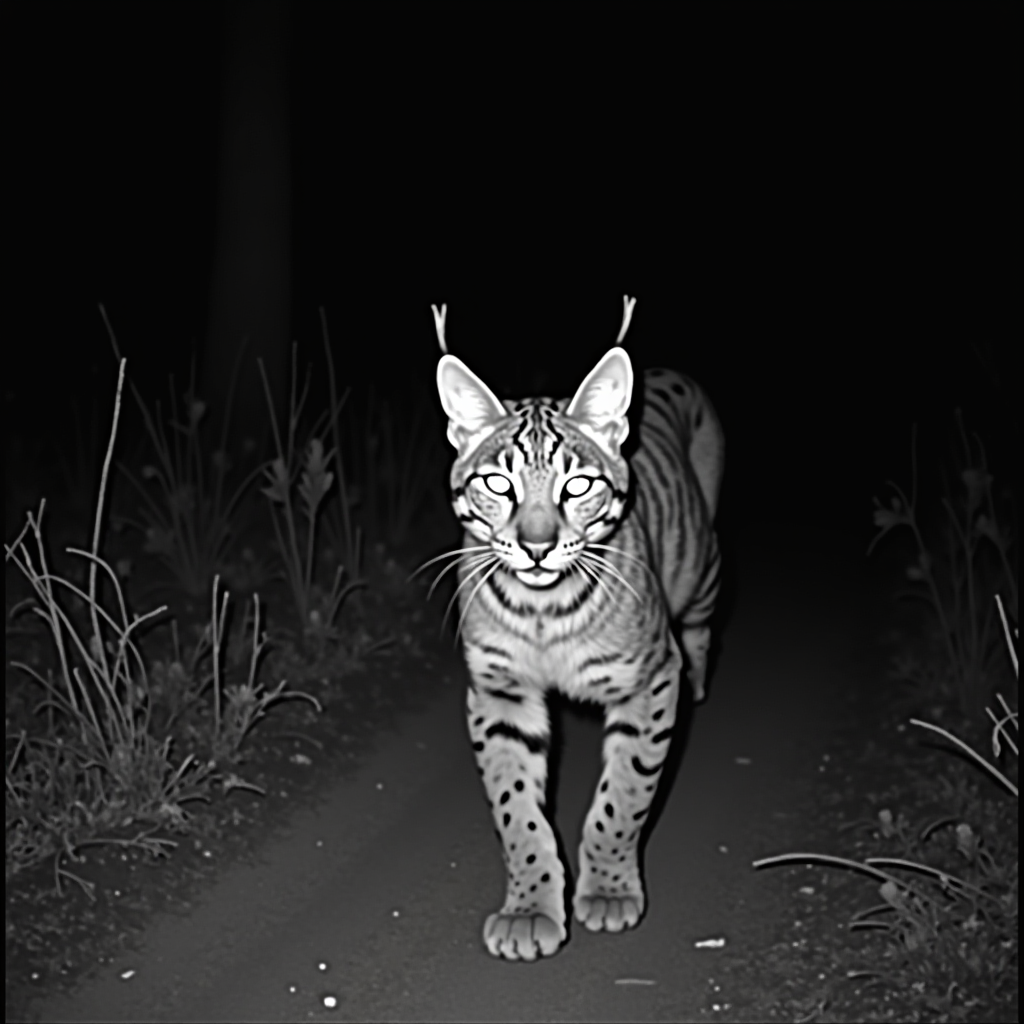
A bobcat captured by our camera trap system at 2:47 AM, demonstrating the stealth and grace of these nocturnal hunters
Masters of the Night Sky: Owls as Apex Aerial Predators
While bobcats patrol the ground, owls command the airspace above Rancho SMC with unparalleled hunting prowess. Our preserve provides habitat for five owl species: the Great Horned Owl, Barn Owl, Western Screech-Owl, Long-eared Owl, and the occasional Northern Pygmy-Owl. Each species has evolved specialized adaptations that make them supremely effective nocturnal hunters.
The Great Horned Owl (Bubo virginianus), our largest resident owl species, exemplifies the remarkable sensory capabilities that define these birds. Their asymmetrically positioned ears allow them to pinpoint prey location with extraordinary precision—they can detect a mouse moving beneath snow from over 100 feet away. Their flight feathers feature specialized serrations that break up turbulent air, enabling virtually silent flight that gives prey no warning of their approach. This combination of acute hearing and silent flight makes them devastatingly effective predators.
Barn Owls (Tyto alba) bring a different set of adaptations to their hunting strategy. Their heart-shaped facial disc functions as a parabolic reflector, channeling sound waves to their ears with remarkable efficiency. Studies have shown that Barn Owls can hunt in complete darkness using hearing alone, a capability that proves invaluable during moonless nights or when hunting in dense vegetation. At Rancho SMC, our Barn Owl population has shown a 23% increase over the past three years, likely responding to our habitat restoration efforts that have expanded suitable nesting sites and increased prey availability.
Conservation Impact: A single Barn Owl family can consume over 3,000 rodents annually, providing natural pest control that benefits both native ecosystems and surrounding agricultural lands. This ecosystem service has an estimated economic value of $75-100 per owl per year in reduced crop damage and decreased need for chemical rodenticides.
The ecological role of owls extends beyond simple predation. By controlling rodent populations, they prevent the boom-and-bust cycles that can destabilize plant communities and create conditions favorable for invasive species. Their presence also indicates ecosystem health—owls require intact food chains, suitable nesting habitat, and minimal human disturbance, making them excellent indicator species for conservation monitoring.
The Misunderstood Guardians: Bats and Their Critical Ecosystem Services
Perhaps no nocturnal predators face greater misconceptions and undeserved fear than bats. Yet these remarkable mammals provide ecosystem services valued at billions of dollars annually through insect control and pollination. Rancho SMC supports populations of at least nine bat species, including the threatened Townsend's Big-eared Bat and the Western Red Bat, making our preserve a regional stronghold for bat conservation.
The insectivorous bats at Rancho SMC consume staggering quantities of flying insects each night. A single Little Brown Bat can eat up to 1,000 mosquito-sized insects per hour during peak feeding periods. Extrapolating across our estimated bat population of several thousand individuals, these nocturnal hunters remove millions of insects from the ecosystem nightly, including agricultural pests, disease vectors, and species that would otherwise damage native vegetation.
Our acoustic monitoring program, which uses specialized microphones to record bat echolocation calls, has revealed fascinating patterns in bat activity and species distribution. Different bat species hunt at different heights and in different habitats, creating a three-dimensional mosaic of predation pressure that affects insect populations throughout the vertical structure of the ecosystem. Mexican Free-tailed Bats hunt high in the open sky, Myotis species forage along water surfaces and in forest gaps, while Townsend's Big-eared Bats glean insects from vegetation in dense woodland areas.
Population Status and Conservation Challenges
Despite their ecological importance, bat populations face unprecedented threats. White-nose syndrome, a fungal disease that has devastated bat populations across North America, has not yet reached our region, but its westward spread represents an existential threat to many species. Climate change affects insect availability and hibernation patterns, while habitat loss eliminates crucial roosting sites. At Rancho SMC, we've implemented several conservation measures to support bat populations, including the installation of artificial roost structures, protection of natural roosting sites in old buildings and trees, and maintenance of water sources that provide drinking opportunities and concentrate insect prey.
Our monitoring data shows stable to increasing populations for most species, a encouraging trend that contrasts with regional declines documented elsewhere. This success likely reflects our comprehensive habitat management approach that maintains diverse vegetation structure, protects water quality, and minimizes artificial lighting that can disrupt bat foraging behavior. The presence of nine bat species at Rancho SMC represents approximately 60% of the bat diversity found in our entire region, underscoring the preserve's importance as a bat conservation refuge.
Camera Trap Revelations: New Insights into Nocturnal Behavior
The implementation of our camera trap program in 2022 has revolutionized our understanding of nocturnal predator ecology at Rancho SMC. Using a network of 45 motion-activated cameras equipped with infrared illumination, we've accumulated over 50,000 images and videos that document previously unknown aspects of predator behavior, habitat use, and interspecific interactions.
One of the most significant discoveries involves temporal partitioning among predators. Our data reveals that bobcats, coyotes, and gray foxes—all of which hunt similar prey—reduce competition through subtle differences in activity timing. Bobcats show peak activity between 10 PM and 2 AM, coyotes are most active from 3 AM to dawn, while gray foxes concentrate their hunting during the twilight hours of dusk and early evening. This temporal separation allows multiple predator species to coexist by reducing direct competition for prey resources.
The camera traps have also documented fascinating behavioral sequences that would be nearly impossible to observe through traditional field methods. We've captured bobcats teaching hunting techniques to their kittens, owls caching prey for later consumption, and complex interactions between predators and their prey that reveal the constant evolutionary arms race between hunter and hunted. One particularly remarkable sequence showed a bobcat and a Great Horned Owl simultaneously hunting the same area, each apparently aware of the other's presence but maintaining a respectful distance.
"The camera trap data has fundamentally changed how we understand predator ecology at Rancho SMC. We're seeing behaviors and patterns that challenge textbook assumptions about these species. Every week brings new discoveries that inform our conservation strategies."
— Dr. Maria Gonzalez, Wildlife Ecologist, Rancho SMC Research Team
Perhaps most importantly, the camera trap program has revealed the extent to which nocturnal predators utilize habitat corridors and movement pathways across the landscape. By identifying critical travel routes, we can prioritize these areas for protection and enhancement, ensuring that predators can move safely between different parts of their territories. This information proves invaluable for land management decisions and helps us design conservation strategies that maintain landscape connectivity essential for long-term population viability.
The Interconnected Web: Ecological Relationships and Cascade Effects
Understanding nocturnal predators requires appreciating their position within complex ecological networks. These hunters don't exist in isolation—they're embedded in intricate webs of relationships that connect them to prey species, competing predators, scavengers, parasites, and even plants through indirect pathways that can span multiple trophic levels.
Consider the relationship between owls, rodents, and oak trees at Rancho SMC. Owls control rodent populations, preventing excessive seed predation that would otherwise limit oak regeneration. Healthy oak populations provide acorns that support diverse wildlife communities, create structural habitat complexity, and influence soil chemistry and water retention. The presence or absence of owls thus ripples through the ecosystem in ways that extend far beyond simple predator-prey dynamics.
Similarly, bats influence plant communities through their effects on insect herbivores. By consuming moths, beetles, and other insects that feed on vegetation, bats reduce herbivory pressure and allow plants to allocate more resources to growth and reproduction rather than defense. Research in similar ecosystems has shown that areas with healthy bat populations support 15-25% greater plant biomass compared to areas where bats have been eliminated, demonstrating the far-reaching consequences of predator conservation.
Bobcats create additional complexity through their role as mesopredators. By controlling populations of smaller predators like raccoons and skunks, bobcats indirectly benefit ground-nesting birds and other species vulnerable to nest predation. This "mesopredator release" phenomenon—where removal of larger predators leads to population explosions of smaller predators—has been documented across North America, highlighting the importance of maintaining complete predator communities.
Conservation Implications and Future Directions
The insights gained from studying nocturnal predators at Rancho SMC carry profound implications for conservation strategy and land management. These species serve as umbrella species—protecting their habitat requirements simultaneously conserves the needs of countless other organisms that share their ecosystems. By focusing conservation efforts on maintaining healthy populations of bobcats, owls, and bats, we create conditions that benefit entire ecological communities.
Our research has identified several priority actions for nocturnal predator conservation. First, maintaining habitat connectivity remains paramount. Predators require large territories and the ability to move across landscapes to find mates, establish territories, and access seasonal resources. We're working with neighboring landowners and conservation organizations to identify and protect wildlife corridors that link Rancho SMC to other natural areas, creating a network of connected habitats that supports viable predator populations.
Second, we're addressing the impacts of artificial lighting, which can disrupt nocturnal predator behavior and reduce hunting efficiency. Our "dark sky" initiative aims to minimize light pollution at the preserve while educating the surrounding community about the importance of darkness for nocturnal wildlife. Early results suggest that areas with reduced artificial lighting show 40% higher bat activity and increased bobcat use, demonstrating the tangible benefits of this approach.
Third, we're expanding our monitoring efforts to track population trends and detect early warning signs of decline. The camera trap network continues to grow, and we're incorporating new technologies including acoustic monitoring for bats and owls, GPS tracking of individual bobcats, and environmental DNA sampling to detect species presence. These tools provide increasingly sophisticated understanding of predator ecology and allow us to adapt management strategies based on the best available science.
Looking Forward: Our five-year strategic plan includes establishing Rancho SMC as a regional center for nocturnal predator research, expanding educational programs that connect the public with these remarkable animals, and developing replicable conservation models that can be applied across similar ecosystems throughout the region.
Conclusion: Embracing the Night
The nocturnal predators of Rancho SMC remind us that conservation extends beyond the daylight hours and the charismatic megafauna that typically capture public attention. Bobcats, owls, and bats represent essential components of healthy ecosystems, providing services that benefit both wildlife and human communities. Their presence indicates ecological integrity, their absence signals environmental degradation.
As we continue to study these remarkable creatures through our camera trap program and other research initiatives, we're constantly reminded of how much remains to be discovered. Each night brings new revelations about behavior, ecology, and the intricate relationships that bind species together in complex webs of interdependence. These discoveries don't just advance scientific knowledge—they inform practical conservation actions that make real differences for wildlife populations.
The guardians of the night at Rancho SMC face an uncertain future shaped by climate change, habitat loss, disease, and human disturbance. Yet they also benefit from growing recognition of their ecological importance and expanding conservation efforts dedicated to their protection. By continuing to study, protect, and celebrate these nocturnal predators, we invest in the health and resilience of entire ecosystems, ensuring that the night remains alive with the sounds and movements of these extraordinary hunters for generations to come.
We invite you to join us in this conservation journey. Whether through supporting our research programs, participating in educational events, or simply taking time to appreciate the nocturnal wildlife in your own community, everyone can contribute to protecting these guardians of the night. Together, we can ensure that bobcats continue to prowl, owls continue to hunt, and bats continue to fill the night sky—maintaining the ecological balance that sustains all life at Rancho SMC and beyond.